5 hours ago
Dame Judi Dench Lives Boldly Despite Vision Loss "I Don't Want to Retire"
READ TIME: 5 MIN.
There's something particularly poignant about a woman who has spent seven decades commanding stages and screens—captivating millions with her expressive gaze, her penetrating stare, her ability to communicate entire emotional landscapes through the windows of her eyes—now unable to see the faces of the people she loves most. Yet that's the reality Dame Judi Dench has been navigating for over a decade, and recently, the 90-year-old British icon decided to speak openly about it in a way that feels both heartbreaking and unexpectedly empowering.
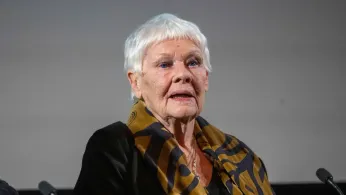
In a November 25 interview with ITV News, conducted alongside her longtime friend and collaborator Sir Ian McKellen, Dench revealed the devastating progression of her age-related macular degeneration , a condition she was first diagnosed with in 2012. The central vision loss caused by AMD is the leading cause of blindness in adults over 50, yet it remains one of those health conditions that often goes unspoken—tucked away behind closed doors, managed quietly, rarely discussed in the kinds of frank, public conversations that might help others feel less alone.
When asked directly why she had largely stepped away from the big screen, Dench didn't soften the blow or reach for euphemisms. "It's because I can't see anymore," she said plainly.
What followed was a moment of genuine human connection that transcended the typical celebrity interview. McKellen, 86 himself and navigating his own aging process, offered a gentle reassurance: "But we can see you." Dench's response was both witty and devastating: "Yes, and I can see your outline, and I know you so well, but I can't recognize anybody now."
For those unfamiliar with macular degeneration, it's worth understanding what Dench is actually experiencing. AMD affects central vision—the part of sight that allows us to recognize faces, read, drive, and perform detailed tasks. Peripheral vision typically remains intact, which means people with AMD can navigate spaces but often cannot identify who's in front of them. It's an invisible disability in the truest sense, one that can be misread by others as rudeness, coldness, or deliberate distance.
Dench addressed this head-on, noting that people often misinterpret her inability to see as snobbery or aloofness. "People think 'oh get her she's got very grand' but it's because I can't see, "she explained with characteristic honesty. She admitted with a laugh that she sometimes greets strangers by mistake, a vulnerability that humanizes the experience of living with vision loss in a world that doesn't always account for invisible disabilities.
The practical ramifications extend into nearly every corner of her daily life. She cannot watch television or read. Her partner, David Mills, sometimes has to cut up her food because she cannot see what's on her plate. These are the unglamorous realities of aging with a progressive condition—moments that don't make it into interviews unless someone is brave enough to name them.
For an actress, vision loss presents a particularly acute professional crisis. Dench's legendary photographic memory—the ability to absorb entire scripts and deliver performances with seemingly effortless precision—has been rendered nearly useless by her condition. How do you memorize lines when you can't see the page? How do you know where a line falls in a script when you can't see it written out?
Rather than surrender, Dench has had to fundamentally reimagine her process. "I've had to find another way of learning lines and things, which is having great friends of mine repeat them to me over and over and over again," she shared at a 2021 Vision Foundation event. "So I have to learn through repetition, and I just hope that people won't notice too much if all the lines are completely hopeless!"
On Graham Norton's show, she elaborated on the specific challenge: "I need to find a machine that not only teaches me my lines but also tells me where they appear on the page. I used to find it very easy to learn lines and remember them. I could do the whole of Twelfth Night right now." There's something almost poetic in that statement—the acknowledgment of what she's lost paired with the ghost of what she could still do, if only the mechanics of her condition would allow it.
Her last feature film appearance was in 2022's "Allelujah." In May 2024, when asked at the Chelsea Flower Show if she planned to take on more roles, her response was direct: "No, no, I can't even see!"
Yet here's where Dench's story becomes something more than a tragedy narrative—the kind of cautionary tale about aging that culture often peddles. Despite the genuine limitations imposed by her condition, she has consistently resisted the language of retirement or surrender. When speaking with Louis Theroux in 2022, she was explicit: "I don't want to retire. I'm not doing much at the moment because I can't see. It's bad."
That distinction matters enormously. She's not saying she can't work. She's not saying she's done. She's saying that right now, given her current circumstances, major film and stage productions aren't feasible. But the door remains open. The possibility remains alive. And that refusal to accept a predetermined narrative about what her later years "should"look like is genuinely radical.
Dench hasn't completely stepped away from performance. She recently appeared in a Christmas campaign for ShelterBox, a UK-based disaster relief charity, alongside fellow Dame Imelda Staunton. It's a reminder that visibility and contribution don't have to take the form they once did. They can be smaller, more intimate, adapted to current capacity—and still meaningful.
More significantly, Dench and McKellen have been channeling their energies into education and cultural transmission. They're backing a hands-on approach to teaching Shakespeare that involves secondary students acting out scenes rather than passively reading from texts. In this work, Dench isn't performing for an audience; she's passing knowledge forward, ensuring that the art form she's dedicated her life to continues to live and breathe in new generations.
For LGBTQ+ audiences, Dench's openness about her condition carries particular resonance. Our community has long understood the power of visibility—the radical act of showing up, being seen, and refusing to hide. We've also learned, sometimes painfully, about invisible struggles: the mental health crises that don't show on the outside, the chronic illnesses that don't announce themselves, the ways that people can be profoundly struggling while appearing to have it all together.
Dench's willingness to name her condition, to discuss its impact candidly, and to refuse both pity and the pressure to disappear models something important. It's not inspiration porn—the toxic tendency to celebrate disabled people simply for existing. It's something more honest: an acknowledgment that aging, illness, and disability are part of the human experience, and that they don't erase a person's value, agency, or capacity to contribute to the world.
She's still here. She's still thinking, creating, mentoring, and yes, still performing when she can. She's adapted. She's found workarounds. And she's made it clear that her life isn't over—it's just different than it was before.
At 90, Dame Judi Dench continues to teach us about visibility in all its forms.